



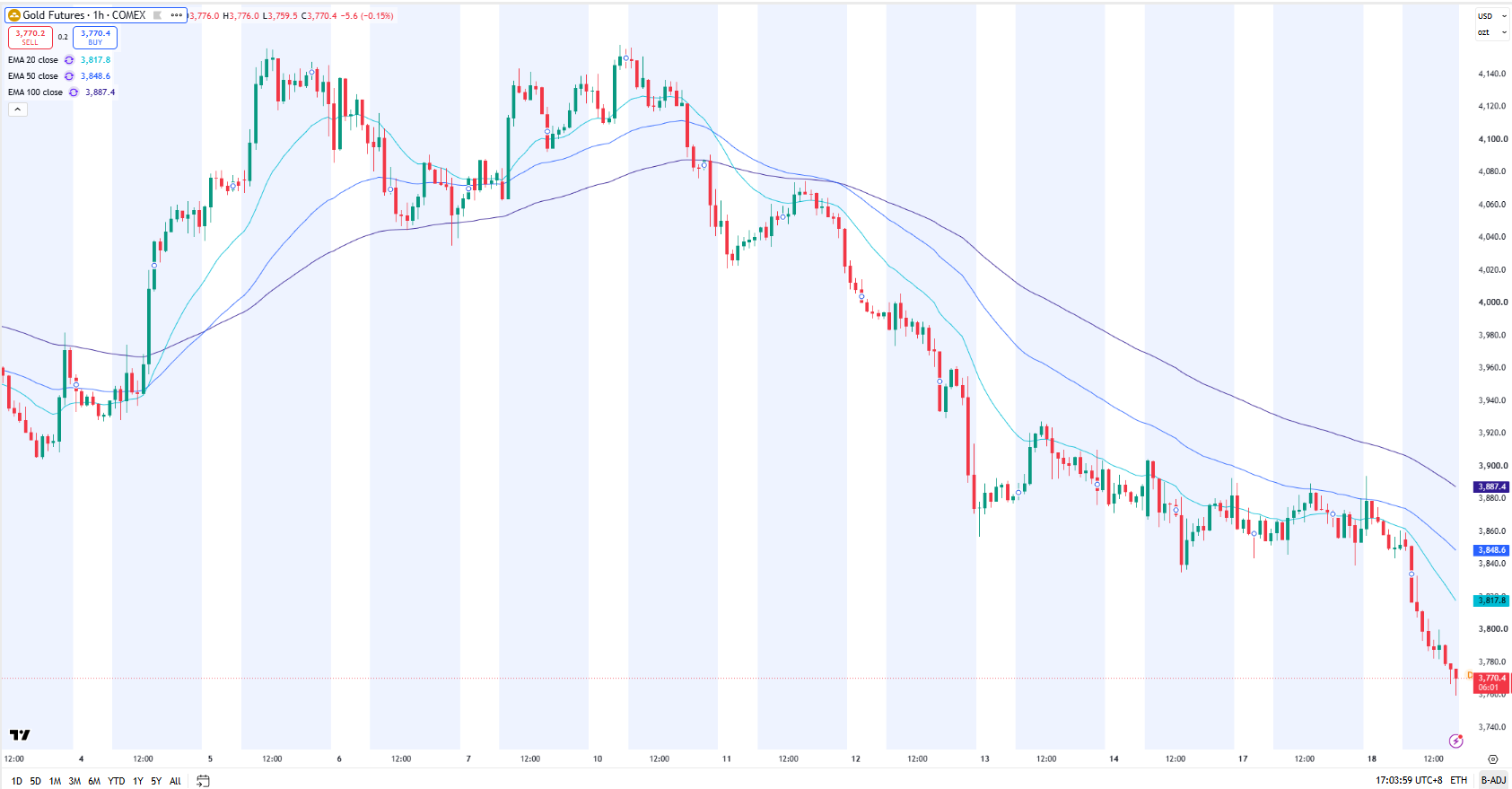
Gold extended its decline on Wednesday, 18 November, falling below US$3,800 per ounce and approaching its lowest level in 14 months, as expectations of further interest rate hikes by the US Federal Reserve continued to weigh on precious metals.
Spot gold declined approximately 1.5% to US$3,790 per ounce in early trading, extending a prolonged correction that has seen bullion lose more than a quarter of its value since the US-Iran conflict began in late February.
Hawkish Fed Outlook Weighs on Gold
Persistent inflationary pressures have reinforced expectations that the Federal Reserve may need to maintain restrictive monetary policy for longer.
Recent comments from Federal Reserve officials suggest that additional interest rate increases could be necessary to bring inflation back towards the central bank’s 2% target. Markets are currently anticipating further rate hikes in December and January, with another increase potentially following by April.
The prospect of higher borrowing costs has also supported US Treasury yields, with the benchmark 10-year yield remaining above 5%.
This presents a challenging environment for gold. As a non-interest-bearing asset, bullion generally becomes less attractive when investors can obtain higher yields from fixed-income instruments. A firmer US dollar adds further pressure by making gold more expensive for buyers holding other currencies.
Geopolitical Tensions Add to Inflation Concerns
While geopolitical uncertainty traditionally supports demand for safe-haven assets such as gold, the ongoing US-Iran conflict has created a different dynamic.
Higher energy prices stemming from the conflict have contributed to inflationary pressures, prompting expectations of tighter monetary policy. Consequently, the potential impact of higher interest rates has outweighed gold’s traditional appeal as a geopolitical hedge.
This highlights the complex relationship between geopolitical risks and precious metals, where inflation expectations and monetary policy developments can sometimes exert a greater influence on prices than safe-haven demand.
Could Gold Find Support After Its Sharp Correction?
Despite the near-term weakness, some market analysts maintain a constructive medium- to long-term outlook for gold.
Further monetary tightening could extend the current correction, although renewed buying interest may help establish support around US$3,600 per ounce.
Looking further ahead, some analysts see the potential for gold to recover towards US$4,800 in 2027, supported by renewed investment demand and concerns surrounding US fiscal policy, government debt and political uncertainty.
However, the pace and sustainability of any recovery will likely depend on the Federal Reserve’s monetary policy trajectory, movements in US Treasury yields and broader investor sentiment.
What’s Next for Gold?
Investors will be closely monitoring the Federal Reserve’s October meeting minutes for further clues on the trajectory of US interest rates.
In the near term, the direction of Treasury yields, the US dollar and inflation expectations could remain key influences on gold prices.
While the prospect of additional rate hikes may continue to weigh on bullion, renewed buying interest and persistent fiscal uncertainty could provide a foundation for a longer-term recovery.
Ready to trade smarter? Visit Phillip Capital Malaysia to explore the tools and platforms available for trading commodities in 2026.