




If you have used an AI assistant at work, or a tool that helps write software, you may already have used Claude without knowing it. Developed by Anthropic, Claude is the AI model family behind one of the fastest-growing businesses in the artificial intelligence (AI) industry.
Anthropic is preparing to list on the Nasdaq on 19 Nov (US time) under the ticker symbol ANT.
This IPO is set to raise about US$68.5 billion, potentially making it one of the largest IPOs on record. This article covers what Anthropic does, how fast its business is growing, what lies behind its eye-catching US$104 billion loss, and what investors should weigh before they trade.
Who Is Anthropic?

Founded in 2021 by former OpenAI researchers, Anthropic is a San Francisco AI lab that builds the Claude family of AI models. Its products are used mainly by businesses, software developers and individual users.
What it sells:
- Claude for business and developers — companies can plug Claude into their own apps, services, and pay per usage. Customers can also access Claude through cloud platforms such as Amazon Web Services, Google Cloud and Microsoft Azure.
- Claude Code — an AI coding agent that writes and fixes software, now one of its fastest-growing products.
- Claude apps — paid Pro, Max, Team and Enterprise subscriptions for individuals and companies.
Anthropic operates as a public benefit corporation. This means, by law, its board is required to balance shareholder returns and its stated public benefit mission of development and maintenance of advanced AI for the long-term benefit of humanity.
Why it matters: Unlike consumer-led AI firms, most of Anthropic’s money comes from businesses. This model can benefit from customers integrating Claude into their daily operations, potentially supporting recurring demand. However, the company also relies on major cloud and infrastructure partners to develop and deliver its services.
The IPO At A Glance

| Item | Detail |
|---|---|
| Company | Anthropic, PBC (a public benefit corporation) |
| Exchange / Ticker | Nasdaq / ANT |
| IPO Price | US$83 per share |
| Shares Offered | 825 million |
| Amount Raised | ~US$68.5 billion at the US$83 IPO price |
| Last Private Valuation | US$965 billion (May 2026 funding round) |
| Price Vs Revenue | ~13.5x run-rate revenue of ~US$81 billion at the US$83 IPO price (run-rate is explained under “How Anthropic makes money”). For comparison, Microsoft trades at 11.11x sales (Bloomberg, as of 17 Nov 2026) |
| Pricing | 18 Nov 2026 (US evening) |
| Expected First Trade | 19 Nov 2026 (US time), likely late 19 Nov or early 20 Nov in Malaysia |
So what? The final price of US$83 was set on 18 November, above the top of the US$70 – 78 indicative range, which points to strong demand. Note that dates are planned and can still move.
The US$104 Billion Loss: Mostly An Accounting Effect
At first glance, Anthropic’s headline loss looks alarming, but about US$94.3 billion of its US$104 billion net loss for January to September 2026 is a non-cash accounting charge. Over the same nine months, the business actually brought in US$6.6 billion of cash from operations.
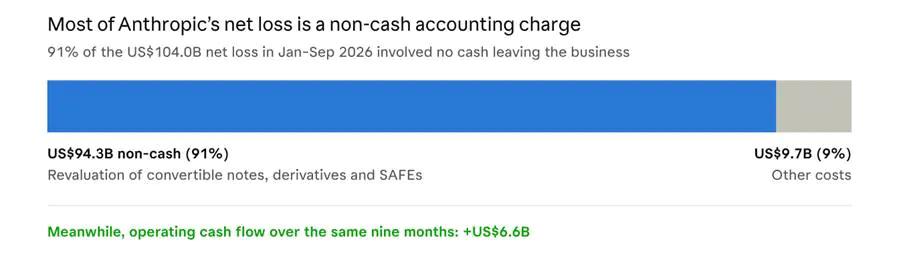
Why it happens: Before listing, Anthropic raised capital through financial instruments that turn into shares at a later date. As the company’s valuation soared, the estimated value of those instruments also rose. Accounting rules require these changes in value to be recognised in the company’s financial statements, even though no cash leaves the business.
Keep in mind: While this explains why the reported net loss is large, the company still spends heavily and lost money running the business in Q3 2026. Conversion of these instruments into shares also adds to the share count, which dilutes existing shareholders.
How Anthropic Makes Money

Anthropic’s revenue has expanded rapidly. It generated US$33.2 billion in revenue during the first nine months of 2026, compared with US$4.6 billion for the whole of 2025. For comparison, revenue for the first nine months of 2025 was US$2.5 billion. About 80% of revenue is pay-as-you-use: businesses pay for the amount of AI work Claude does. The rest comes from subscriptions.
| Metric (first 9 months of 2026) | Figure |
|---|---|
| Usage-Based Revenue | US$26.3B (79%) |
| Subscription Revenue | US$6.9B (21%) |
| Customers Paying >US$100K A Year | 11,900+ (from 950+ a year earlier) |
| Customer Concentration | No customer is more than 10% of revenue; the top five make up ~25% |
| Annualised Run-Rate Revenue (31 Oct 2026) | ~US$81B |
What is run-rate revenue? Run-rate revenue is an estimate of how much a company could generate over a year if its latest revenue-generating activity continued at the same pace (e.g. multiplying the latest month’s revenue by 12). It provides a snapshot of the business’s current scale without waiting for a full year of results. But this is not the same as actual annual revenue. It assumes that the company’s recent growth and customer activity can be sustained, which may not always be the case.
The takeaway: Growth this fast is exceptional, but it is very hard to keep up, and the share price will be judged on whether it does.
Financials Snapshot

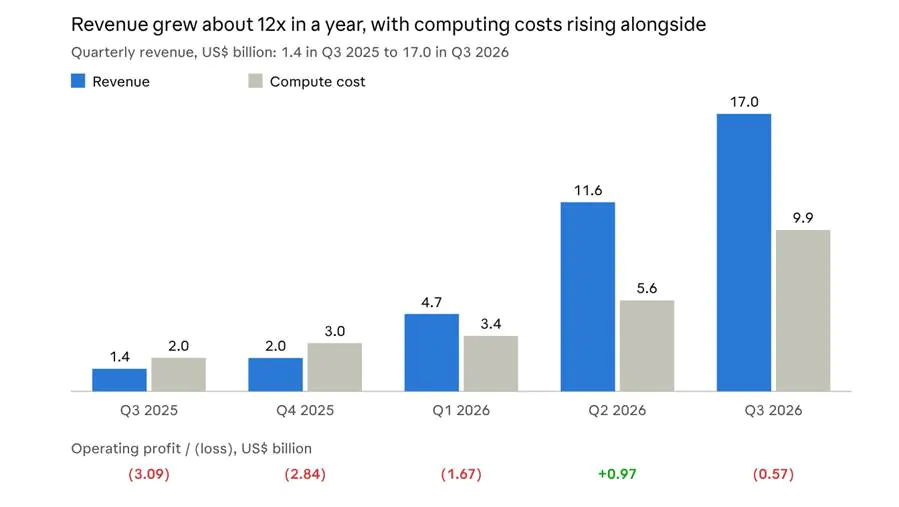
Revenue is growing very fast, and the business is close to breaking even on its operating result: the profit or loss from actually running the business, before accounting adjustments. It made its first operating profit, US$974 million, in Q2 2026, then slipped to a US$567 million operating loss in Q3 as computing costs jumped.
Big computing bills ahead. Anthropic has committed about US$900 billion to Broadcom, Google, Amazon, Microsoft and other suppliers over the coming years, with ~US$71 billion due within 12 months of 30 September 2026.
Key number to watch: Computing cost as a share of revenue. It fell to 48% in Q2 2026, then rose to 58% in Q3.
Upside Vs Risks

Anthropic offers rare, fast growth in AI, but buyers take on huge computing bills, little say in how the company is run, and a rich price.
| Why Investors Are Excited | Key Risks | |
|---|---|---|
| Growth | Q3 2026 revenue of US$17.0B, over 12x a year earlier | Growth this steep is hard to keep up |
| Customers | 11,900+ customers pay over US$100K a year; none is more than 10% of revenue | 44% of revenue is sold through Amazon, Google and Microsoft clouds, which also compete with it |
| Profitability | First operating profit in Q2 2026; +US$6.6B operating cash flow in nine months | ~US$900B committed to computing; compute cost rose to 58% of revenue in Q3 |
| Products | Claude Code reached US$1B annualised revenue within six months of launch | Fierce competition from OpenAI, Google and others |
| Control | Safety-first mission is central to the brand | Founders hold 50.1% of votes and a trust elects most of the board; as a public benefit corporation, profit is not the only goal |
| Timing | Bloomberg reports the IPO is multiple times oversubscribed | AI stocks have sold off sharply since October, led by chipmakers such as Nvidia |
Bottom line: Strong fundamentals do not guarantee a strong share price. Newly listed stocks can swing both ways sharply in their first weeks and months.
Experience Modern Trading Today
TradingView delivers a modern trading experience that combines speed, flexibility, and powerful analytics.
With low commissions, professional-grade tools, and multi-market access, it’s a smarter, more efficient way to trade. And with the trusted name of Phillip Capital behind it, you can trade with confidence.
Ready to trade smarter and faster? 👉 Open an account today and link it to TradingView to unlock the future of trading — all on one screen.
Explore Phillip Capital’s platforms and tools and implement these insights effectively.

“`