




Crude Oil Ends 2025 Under Pressure as Oversupply Weighs on Prices
Crude oil markets are grinding through the final weeks of 2025 with prices largely subdued, reflecting a tug-of-war between persistent bearish fundamentals and intermittent bullish headlines. Brent crude has been hovering just above the $60 per barrel mark, while West Texas Intermediate (WTI) has been trading near the mid-$50s, with both benchmarks testing multi-year lows as the year closes out. Throughout 2025, price action has shown modest rebounds on geopolitical headlines, while the broader narrative points to a balance of sluggish demand and oversupply. Overall, the trend remains weak as structural supply concerns eclipse short-lived risk-off rallies.
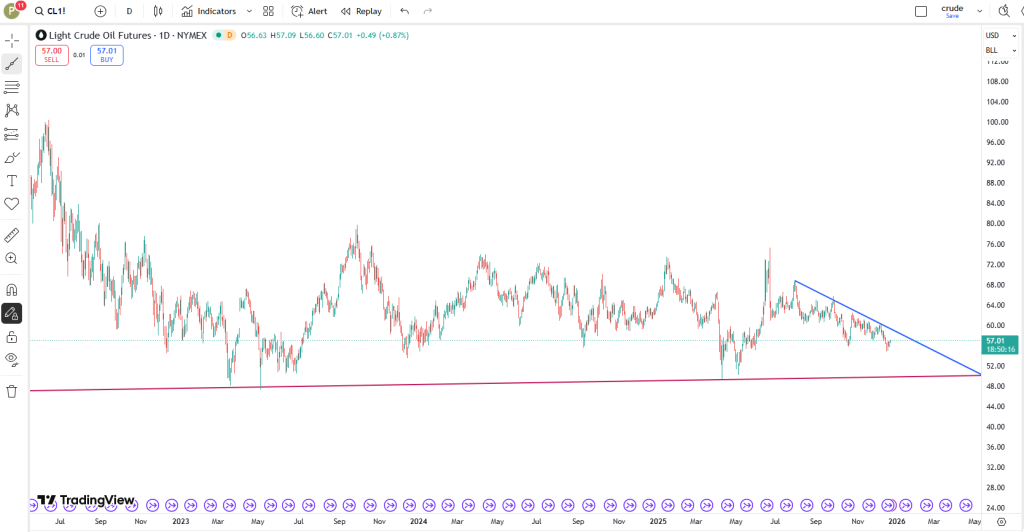
From a fundamental perspective, the market’s narrative remains dominated by oversupply. EIA and IEA forecasts indicate global production continuing to outpace demand growth through 2026, with inventories building steadily. Markets are convinced of supply expansions from non-OPEC producers in the U.S., Brazil, Canada, and others. Even with China accelerating crude stockpiling — which provides temporary support — much of this reflects strategic buildup rather than stronger immediate consumption. Global demand growth, while positive, is muted relative to supply additions, keeping the supply-demand balance skewed toward oversupply and underpinning a bearish backdrop for prices.
Market expectations that the Federal Reserve will continue to cut rates into 2026 have provided occasional support for oil and broader risk assets by lowering real yields and easing dollar strength. However, even with these macro tailwinds, oil’s price response has been limited, suggesting demand prospects remain constrained. Chinese demand has slowed from earlier forecasts, and in Europe, economic growth is lacklustre, reducing fuel consumption and oil demand.
Technically, crude futures are consolidating in a range that points to sideways trading with a bearish skew. Immediate support sits around the mid-$50s, a critical pivot that has halted deeper declines recently. Meanwhile, upside resistance clusters near the $57–$60 per barrel mark, which has been limiting short-term trading flare-ups. A break below the lower support zone could expose deeper downside toward $50 per barrel, a level flagged by technical analysts as the next major floor if inventories remain elevated. A price point of $50 per barrel for WTI also coincides with a level at which producers rethink production quantities, as profit margins become questionable.
More recently, sanctions on Russian barrels, OPEC+ holding back on further production increases, and the potential loss of Venezuelan oil barrels have triggered intermittent relief rallies in crude prices. However, these flare-ups have largely been short-lived and have failed to generate any sustained upside momentum over the longer run. Seasonal factors are also adding to near-term vulnerability. With Christmas and New Year approaching, the final trading sessions of the year are typically marked by thinner liquidity and more erratic price action, increasing the risk of exaggerated intraday moves without any meaningful shift in the underlying trend.
Unless and until we see substantial economic recovery, which in turn boosts demand for fuel, or a significant crunch in OPEC supplies, the broader picture points to oversupply in 2026 and sombre oil prices.
Looking ahead, oil is expected to trade range-bound, with risks skewed to the downside. Persistent oversupply forecasts for 2026, only modest demand expansion, and growing inventories are likely to cap rallies. Unless OPEC+ shifts policy aggressively to tighten production, or demand unexpectedly accelerates, bearish structural forces are set to remain the dominant theme into the new year.
How to Open an Account and Get Started
Ready to start? Here’s how to open an account with Phillip Nova and connect it to TradingView:
- Visit http://www.phillip.com.my
- Click “Open an Account” and choose “futures’ as your account type.
- Complete your registration and KYC verification.
- Log into your TradingView account, search for Phillip Nova under brokers, and link your account.
- Subscribe to live market data on TradingView for the instruments you want to trade.
Once set up, you’re ready to trade BMD, EUREX futures and commodities futures — all from one powerful interface.
Experience Modern Trading Today

Phillip Nova on TradingView delivers a modern trading experience that combines speed, flexibility, and powerful analytics.
With low commissions, professional-grade tools, and multi-market access, it’s a smarter, more efficient way to trade. And with the trusted name of Phillip Capital behind it, you can trade with confidence.
Ready to trade smarter and faster? 👉 Open a Phillip Nova account today and link it to TradingView to unlock the future of trading — all on one screen.
Explore Phillip Capital’s platforms and tools and implement these insights effectively.